

Last updated: April 2026 · Reviewed by NTW Tire Specialists
Bias-Ply vs. Radial Tires: Which Is Better for Your Truck or Jeep?
Short answer: Radials are the better street tire — they ride smoother, last longer, balance more easily, and stay round overnight. Bias-ply tires are tougher in extreme off-road use (rocks, sharp sidewall hits, deep mud) and have stiffer sidewalls that some rock-crawlers prefer. For 90% of buyers driving any meaningful pavement, the radial wins.
This is the single most-asked question we get on the phone and in our product Q&A. We've answered it hundreds of times for real customers picking Interco Super Swampers, Maxxis Trepadors, and other aggressive off-road tires. Here's the honest version — the same answer our team gives a customer who calls in.
How to Tell if a Tire Is Bias or Radial (Just Read the Size)
The size code on the sidewall tells you everything:
- 33X12.50X15 — an X (or a dash, or a slash) between the numbers means bias-ply
- 33x12.50R15 — an R right before the rim size means radial
That's it. No spec sheet needed. (Quote from our team to a customer shopping the Vortrac AT: "When you see a size and it shows an R right before the rim size, that means radial. If it has an X, /, or - instead of an R, those are bias tires.")
What's Actually Different Inside
The two tires are built differently:
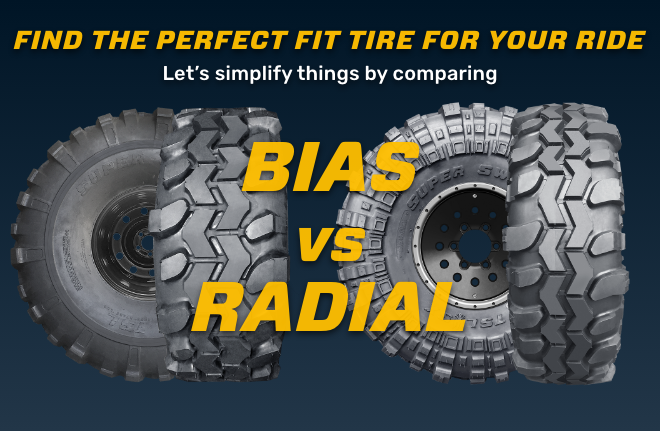
- Bias-ply — carcass plies run diagonally, criss-crossing from bead to bead. Stiff, thick sidewalls. Rugged. Heavy. Flexes as one chunk — tread + sidewall move together.
- Radial — carcass plies run straight across (90° to the direction of travel), with steel belts under the tread. Sidewalls flex independently of the tread. Cooler running. Lighter. Smoother.
Bias vs. Radial: At-a-Glance Comparison
| Bias-Ply | Radial | |
|---|---|---|
| On-road ride | Rough, can flat-spot overnight | Smooth, stays round |
| Highway noise | Loud (very loud on aggressive treads) | Quieter |
| Highway wear / mileage | ~20,000–25,000 miles typical | 40,000+ common |
| Balancing | Hard to balance well | Balances easily |
| Rock crawling | Excellent — stiff sidewall, airs down well | Very good — more flex, more grip patch |
| Mud / deep off-road | Excellent — durable, self-cleaning lugs | Excellent — depends on tread design |
| Sidewall puncture resistance | Better (thicker plies) | Good (depends on ply rating) |
| Heat buildup at speed | Higher | Lower |
| Speed rating | Usually unrated | Usually rated |
| Daily driver? | Not recommended | Yes |
Which One Should You Buy?
Daily-driver truck or Jeep that sees pavement > 50% of the time
Get a radial. Even an aggressive radial mud tire like the Super Swamper TSL Radial or IROK Radial rides better, lasts longer, and balances better than any bias-ply. You'll trade a small amount of off-road bite for a tire you can actually live with.
Dedicated rock-crawler or trail rig (trailered to the trail)
Bias-ply still wins for many builds. Stiff sidewalls hold up when aired down to single-digit PSI on sharp rocks, and the beefier carcass shrugs off the kind of impacts that pinch a radial. IROK Bias, Bogger, and TSL Bias are the classics here.
Mud bog / competition
Either works — depends on the rules and the build. Radials have caught up substantially in the last decade. Talk to us; we sell both.
Mixed-use (some highway, some serious off-road)
Radial, almost always. Modern aggressive radials (TSL Radial, IROK Radial, Maxxis Trepador Radial) give up very little to bias-ply in the dirt and are night-and-day better on the road home. The era of "you need bias for real off-road performance" is mostly over.
A Tall, Narrow Bias-Ply Option
The Gateway Buckshot Mudder P78-16 bias-ply tire is a Load Range C, approximately 32x8.50-16 option intended for dedicated off-road use.
Frequently Asked Questions
Are bias-ply tires DOT approved for the street?
Yes — most off-road bias-ply tires (Super Swamper TSL, IROK Bias, Bogger, SX2) are DOT-approved and street-legal. Legal is not the same as recommended: they're loud, they wear quickly, and they don't ride well. If you're driving the truck to work, get a radial.
How many miles will a bias-ply mud tire last?
Most aggressive bias-ply tires deliver about 20,000–25,000 miles with proper care. Highway use, hot weather, and aggressive driving shorten lifespan.
Why does my bias-ply tire feel "flat" in the morning?
That's normal — bias-ply tires flat-spot overnight. It smooths out after a few miles of driving.
Can I run bias-ply for towing or hauling heavy loads?
Check the load range. Many are load range C or D, which may not be enough for heavy-duty towing vehicles.
Are radial Super Swampers as aggressive as bias version?
Close, but not identical. Radials ride smoother and perform better on highways while still being aggressive.
Do bias-ply tires balance well?
No — they are harder to balance and may cause more vibration compared to radial tires.
What about ATV/UTV bias vs radial?
Radials offer smoother rides and longer life. Bias tires are tougher and better for rough terrains.
Still Not Sure? Call Us.
We sell tires every day to mud-truck guys, rock-crawlers, dual-sport Jeep owners, dually drivers, and overlanders. Call 1-800-847-3287 (8–6 EDT) or message us with your vehicle, your use case, and the size you're considering — we'll tell you straight whether the bias or radial is right for your build.
Browse: Interco Super Swamper Tires · All-Terrain Tires · Mud-Terrain Tires · All Off-Road Tires